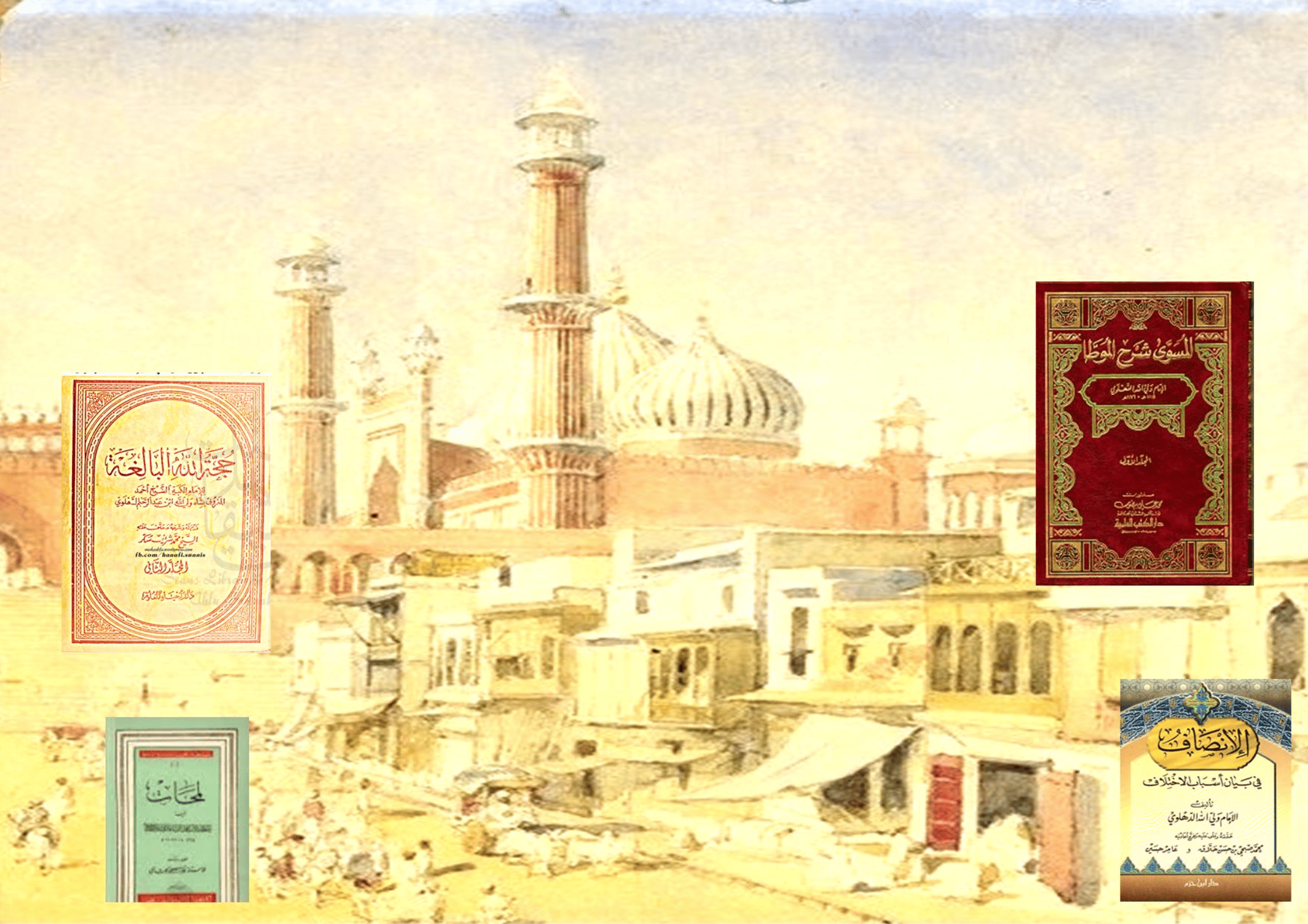
The following is a translation of Shaykh al-Tafsīr Owais Nagrāmī Nadwī's رحمة الله article on 'The Reality of the Zindīq' that was originally published in 1941. Maʿārif is a century-old Urdu monthly scholarly journal published from Azamgarh by Dar al-Musannefīn (Shibli Academy), founded in 1916 to advance rigorous Islamic scholarship, history, and literary thought. It remains one of the most authoritative periodicals in the intellectual tradition of South Asian Islam.
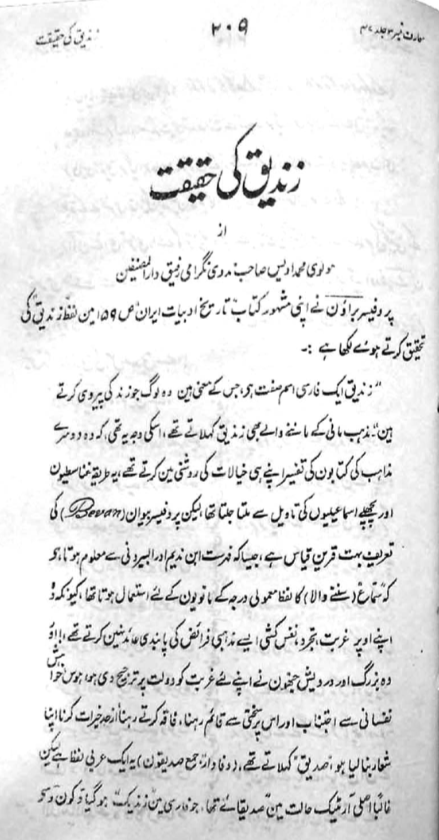
Professor Edward G. Browne, in his well-known work A Literary History of Persia (p. 159), while examining the term zindīq, writes,
“Zindīq” is a Persian adjectival noun meaning those who follow the Zand. The adherents of the religion of Mani were also called zindīqs, because they interpreted the scriptures of other religions in the light of their own ideas. This method resembled the allegorical interpretations (taʾwīl) of the Gnostics and the later Ismāʿīlīs. However, Professor Bevan’s explanation appears more plausible. As is evident from the Fihrist of Ibn al-Nadīm and from al-Bīrūnī, the term samāʿ (“hearer”) was used for ordinary Manichaeans, since they did not impose upon themselves poverty, asceticism, and other rigorous religious obligations. Those elders and dervishes who preferred poverty over wealth, abstained from desire and passion, adopted fasting and excessive charity as their way of life, and embraced a life of renunciation were called ṣiddīq (faithful; plural ṣiddīqūn). This is an Arabic word, but originally in the Aramaic form it was likely ṣaddīqāyā, which in Persian became zandīk, just as certain phonetic changes occur—for example, Persian “sīth” became “shambadh,” and in Sanskrit siddhānta became sandhānta. According to this view, zandīk in Arabic became zindīq, which represents the Persian form of the Aramaic name of the Manichaean gnostics. Initially it was confined to this class, but later came to be used generally for unbelievers.”
Browne preferred this final opinion. However, this line of inquiry appears far removed from the truth when compared to the investigations of Muslim scholars. It is true that in al-Bīrūnī’s Āthār al-Bāqiyah and in the Fihrist of Ibn al-Nadīm, in discussions of the Manichaeans, the terms samāʿ and ṣiddīq are mentioned as names of two groups. Yet this does not necessitate that the origin of zindīq is ṣiddīq.
In Āthār al-Bāqiyah, it is stated, “He instituted laws which the ṣiddīqūn—that is, the righteous and ascetics among the Manichaeans—imposed upon themselves, such as preferring poverty, restraining greed and desire, renouncing the world and practicing asceticism, continuous fasting, giving charity as much as possible, forbidding the possession of more than a day’s sustenance or more than a year’s clothing, and continual travel in the world for preaching and guidance. He also established certain regulations for the samāʿīn, that is, their followers and respondents who remained engaged in worldly affairs.”
Similarly, Ibn al-Nadīm in al-Fihrist, while discussing the Manichaeans, uses the word ṣiddīq in several places and once uses samāʿ. Yet nowhere is there any indication that this word later became zindīq in Persian.
The term zandaqah is used for irreligious and atheistic persons. If its origin were ṣiddīq, referring to the “ṣiddīqūn” of the Manichaean sect, then its usage would necessarily have been more honourable.
Indeed, the word ṣiddīq has been accorded such reverence that when al-Jawharī cited its morphological pattern, he used fāsiq as an example. The author of Lisān al-ʿArab objected, saying, “He has given a poor example in this place.” [Tāj al-ʿArūs]
Lexicographers have determined that zindīq is not originally an Arabic word; rather, it is Persian and subsequently Arabised. In Lisān al-ʿArab it is stated, “Zindīq—one who believes in the eternity of time—is a Persian word that has been Arabised. In Persian its origin is zandakar, meaning one who affirms the perpetual endurance of time.”
In Tāj al-ʿArūs it is stated, “The correct view is that zindīq is derived from Zand, the book of Mani the Magian.”
In al-Khwārizmī’s Mafātīḥ al-ʿUlūm, it is written, “The zanādiqah are the Manichaeans; this was also the name of the Mazdakites. Mazdak appeared during the reign of Qubādh and claimed that property and women were communal. He produced a book called Zand, which was the book of the Magian brought by Zoroaster, whom they regard as a prophet. Therefore, the followers of Mazdak were attributed to Zand, and the word was Arabised as zindīq.”
In Ghiyāth al-Lughāt, it is stated,“The correct view is that it is the Arabised form of zandah—that is, one who believes in the book of Zoroaster and who affirms the doctrines of Yazdān and Ahriman. In accordance with the rules of Arabisation, a yāʾ was added at the end. Since the morphological pattern faʿlīl (with fatḥah) was not known in Arabic usage, the first letter—namely the foreign ‘z’—was given a kasrah. In the treatise Muʿarrabāt and in Khayābān it is written that zindīq (with kasrah) is the Arabised form of zandīk, which itself is composed of zand and the suffix of attribution, or possibly a diminutive form indicating disparagement.”
From these discussions it becomes clear that the origin of zindīq is Persian. The only disagreement concerns what its precise Persian root is. One group maintains that its origin is zandah (living), arguing that such people believed in the eternity and perpetual endurance of time; hence from zandah came zindīq. Another group holds that these people were followers of a book called Zand, and therefore were called zandī and zindīq.
Whether Zand was the book of Zoroaster, of Mani, or of Mazdak—or whether it was the name of a particular language—is a question into which we do not wish to enter, as it lies outside the scope of our present discussion. However, after examining the usage of the term zindīq, we inevitably reach the conclusion that its origin lies in Zand (that is, the name of a book). Otherwise, there is no reason why the word zindīq would be used even in contexts where the doctrine of the eternity of time is not in question.
The celebrated historian al-Masʿūdī has spoken learnedly on this word, and from his discussion the essential reality becomes clear. He writes, “The name zanādiqah appeared during the time of Mani, and from him the term zandaqah was derived. The reality is that when Zoroaster brought to the Persians his book Bastāh, written in the ancient Persian language, its exegesis and commentary came to be known as Zand. Mani introduced into that religion matters which were not originally part of it, indeed which were contrary to the Bastāh. His approach was directed toward Zand (that is, interpretation). From that time people began to say that he was ‘zandī.’ This designation arose because he inclined toward allegorical interpretation and deviated from the outward wording of the original book in favour of explanations contrary to its apparent meaning. When this term entered Arabic usage, it became ‘zindīq.’” [Murūj al-Dhahab]
Al-Masʿūdī’s statement clarifies the essential point: their distinctive practice was corrupt and deviant interpretation. Initially, the word zindīq was specifically applied to the Mazdakite sect and those who embraced Manichaeism. Among certain groups of Quraysh, when it is reported that some individuals “acquired zandaqah,” it clearly means they accepted the Manichaean doctrine.
During the Umayyad period, the usage of this term was limited, for that era was characterised predominantly by devotion to religious knowledge, attachment to the Qurʾān and Sunnah, and little room for speculative distortion. However, during the ʿAbbāsid period, when philosophy gained influence, zandaqah became widespread. Attempts were made to conceal foreign doctrines under Islamic terminology and Qurʾānic and ḥadīth expressions. Thus the term was no longer confined to Manichaeans; rather, it was applied to any individual or group who interpreted religious texts in accordance with their own doctrines, distorting the meanings of the words of the Sharīʿah.
Having understood the true origin of the word, let us now consider how the scholars of Islam defined zindīq in their technical usage, and how closely their definition corresponds to this historical reality.
Ḥāfiẓ Ibn Ḥajar al-ʿAsqalānī, in Fatḥ al-Bārī writes, “It came to be applied to anyone who conceals disbelief while outwardly professing Islam.”
Imam Mālik is reported to have said that the zindīq is essentially the same as the hypocrite (munāfiq).
Shāh Walī Allāh al-Dihlawī, in al-Musawwā states, “If a person opposes the true religion both outwardly and inwardly, he is a kāfir. If he professes it with his tongue but denies it in his heart, he is a munāfiq. If outwardly he affirms the religion but interprets certain of its doctrines in a manner contrary to the understanding of the Ṣaḥābah, the Tābiʿīn, and the consensus of the Ummah, then he is a zindīq. For example, one who says: ‘The Qurʾān is true, and what it mentions of Paradise and Hell is also true—but Paradise signifies merely the happiness arising from noble qualities, and Hell signifies the remorse resulting from blameworthy traits; there exists no real Paradise or Hell beyond this’—such a person is a zindīq.”
A similar definition is given by ʿAllāmah Ibn ʿĀbidīn in Radd al-Muḥtār, and the same is stated in Sharḥ al-Maqāṣid.
Reflect carefully: the ḥadīth scholars, theologians, and jurists apply the term zindīq precisely to those who are guilty of distorting Islam and offering false interpretations. The original crime of the Manichaeans was likewise the adulteration of religion through corrupt exegesis. In reality, the definition given by the scholars of Islam corresponds closely to the historical source of the word. In contrast, deriving zindīq from ṣiddīq is entirely baseless.
The root of ṣiddīq is ṣidq, meaning one who is exceedingly truthful. By its very semantic nature, this word is always used in a favourable sense. By contrast, zindīq is applied to people of falsehood and fabrication. Therefore, between zindīq and ṣiddīq there is not affinity but opposition.