
Life of Shaykh Owais Nagrāmī Nadwī
Shaykh Muḥammad Owais ibn Muḥammad Anīs ibn Muḥammad Idrīs ibn Ḥāfiẓ Sayyid ʿAbd al-ʿAlī al-Nagrāmī al-Nadwī was born on 4 January 1914 in Nagrām, Lucknow, into an illustrious family of scholars. Shaykh Owais began his early education in Nagrām. He later enrolled at Dār al-ʿUlūm Nadwat al-ʿUlamāʾ in 1927, where he studied until 1932 under some of the most distinguished scholars of the age. After completing his formal studies, he pursued advanced training in the Six Books of Ḥadīth, with special emphasis on Ṣaḥīḥ al-Bukhārī and Jāmiʿ al-Tirmidhī. In 1939, he proceeded to Dār al-Muṣannifīn, Aʿẓamgarh, where he came under the direct mentorship of ʿAllāmah Sayyid Sulaymān Nadwī رحمه الله. Upon returning to Lucknow in 1946, Shaykh Owais was appointed Shaykh al-Tafsīr at Dār al-ʿUlūm Nadwat al-ʿUlamāʾ. He held this position for nearly four decades, quietly shaping generations of students through deep Qurʾānic insight, intellectual discipline, and spiritual sobriety. His writings, spanning Arabic, Urdu, and Persian, can be found in some of the most prestigious libraries and universities around the world.
Shaykh Muḥammad Owais Nagrāmī Nadwī رحمه الله undertook the remarkable task of gathering the dispersed Qurʾānic exegetical insights found throughout the writings of Imām Ibn al-Qayyim رحمه الله and compiling them into a single, coherent volume. This work was first published in 1949 in Egypt, where it was warmly received and widely praised by scholars and academic peers. Owing to its scholarly merit, it was subsequently adopted into the curricula of numerous institutions of learning across different parts of the world.
He later set out to undertake a similar project with the works of Shaykh al-Islām Ibn Taymiyyah رحمه الله, but was unable to bring it to completion. Likewise, several of his other scholarly endeavours—particularly in the fields of Arabic grammar (naḥw) and rhetoric (balāghah)—remained unfinished due to prolonged ill health.
Shaykh Owais passed away on the first of Ramaḍān, 27 August 1976. His body was washed by the esteemed Shaykh Manẓūr Nuʿmānī رحمه الله, and he was laid to rest in Lucknow. His janāzah was led by Shaykh ʿAbd al-Ḥasan ʿAlī Nadwī رحمه الله on 28 August 1976. After the burial, Shaykh Manẓūr Nuʿmānī رحمه الله said, “It was because of the Shaykh’s stronghold on adhering and propagating the creed (aqīdah) of Tawḥīd that his face was so relaxed and radiant when laid to rest. It did not appear at all that he had endured such a long illness.” (Kārvān-e-Zindagī) May Allāh have Mercy on the Shaykh and his family, and elevate his ranks in Jannah.
Shaykh Manẓūr Nuʿmānī رحمه الله said concerning him, “Allāh Most High had bestowed upon the Shaykh a special grace, in that He combined within him a number of distinguished qualities that are rarely found together in a single individual...He possessed a deep and abiding attachment to the works of Shaykh al-Islām Ibn Taymiyyah, his eminent student Shaykh Ibn al-Qayyim, and Ḥaḍrat Shāh Walī Allāh al-Dihlawī رحمهُمُ الله تعالى. The particular scholarly temperament and intellectual disposition that naturally emerge from prolonged engagement with the writings of these luminaries were, in fact, precisely Shaykh's own temperament and intellectual outlook.”
His close friend and colleague of over forty years, Shaykh Abū al-Ḥasan ʿAlī Nadwī رحمه الله said, “Our esteemed friend, Shaykh Muḥammad Owais Nagrāmī Nadwī رحمه الله, Professor of Tafsīr at Dār al-ʿUlūm Nadwat al-ʿUlamāʾ, was among the most capable and deeply learned scholars in this noble and exalted discipline of Tafsīr. This distinction was due to his prolonged and meticulous engagement with the works of Shaykh al-Islām Ibn Taymiyyah, Imām Ibn al-Qayyim, and Shāh Walī Allāh al-Dihlawī رحمهُمُ الله تعالى—whose writings he studied with sustained reflection and discernment...Moreover, he was a devoted student of our revered teacher, Sayyid Sulaymān Nadwī رحمه الله, in whose company he spent a considerable period studying the Qurʾān and carefully reading scholarly works. Through this rare combination of profound study, sound methodology, and close companionship with the people of knowledge, Shaykh Muḥammad Owais Nadwī رحمه الله attained a distinguished rank in the science of Tafsīr.”
-------------------------------------------------------------
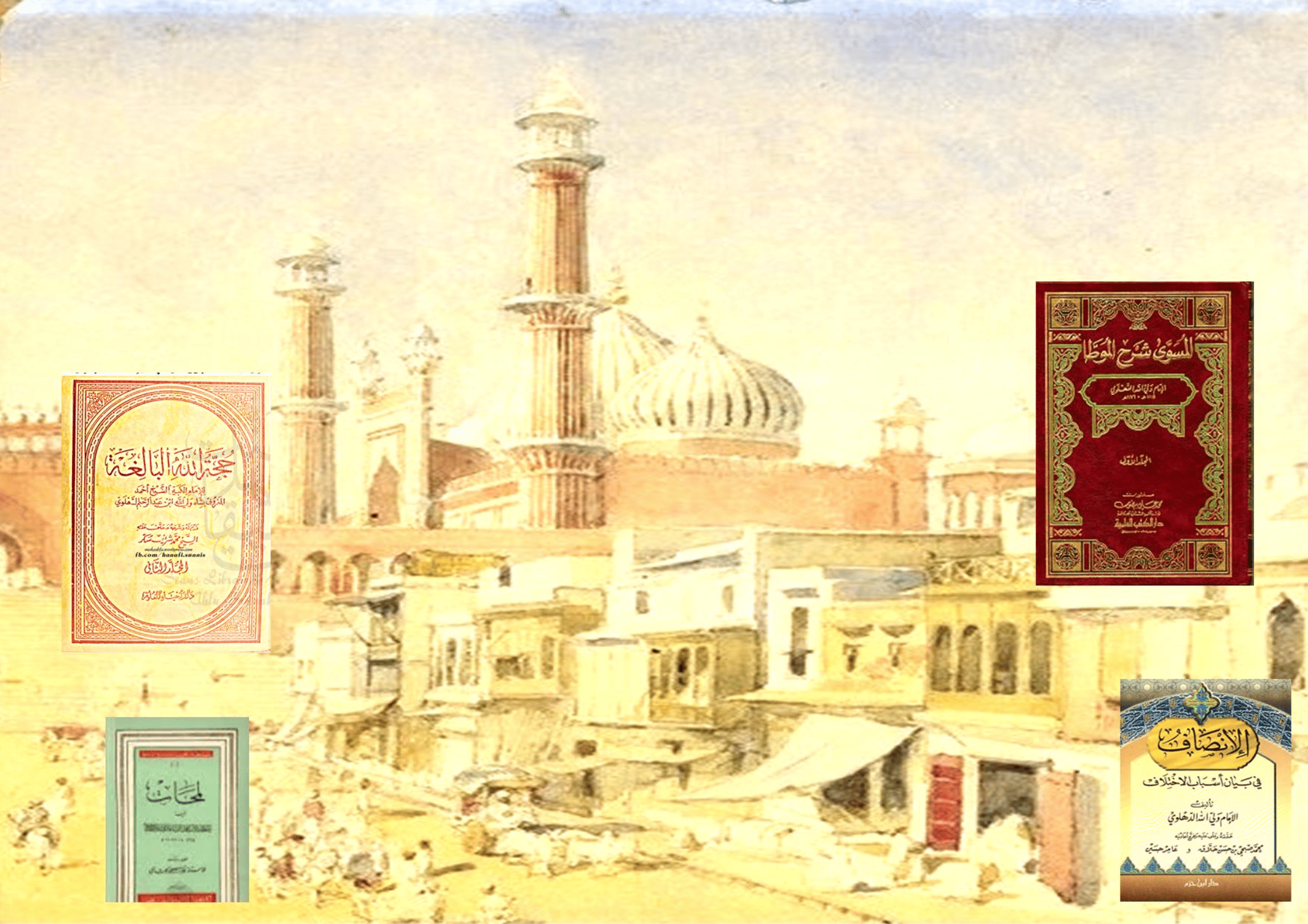
Among the two famous works of Shaykh Owais Nagrāmī Nadwī on Shāh Walī Allāh al-Dihlawī's works are:
1. al-ʿAqīdah al-Sunnīyah fī Sharḥ al-ʿAqīdah al-Ḥasanah: This is a scholarly Arabic commentary in which Shaykh Muḥammad Owais Nagrāmī Nadwī explicates and systematises the concise creed authored by Shāh Walī Allāh al-Dihlawī. The work aims to clarify Sunni doctrinal positions (Ahl al-Sunnah wa-l-Jamāʿah), defend orthodox belief using Qurʾān, authentic Sunnah, and early Salafī authorities, and elucidate Shāh Walī Allāh’s creed in light of classical kalām debates and later theological deviations.
2. al-Khayr al-Kathīr Sharḥ Fawz al-Kabīr: This is a comprehensive Arabic commentary on Fawz al-Kabīr fī Uṣūl al-Tafsīr, the celebrated methodological treatise in which Shāh Walī Allāh laid down foundational principles for understanding the Qurʾān.
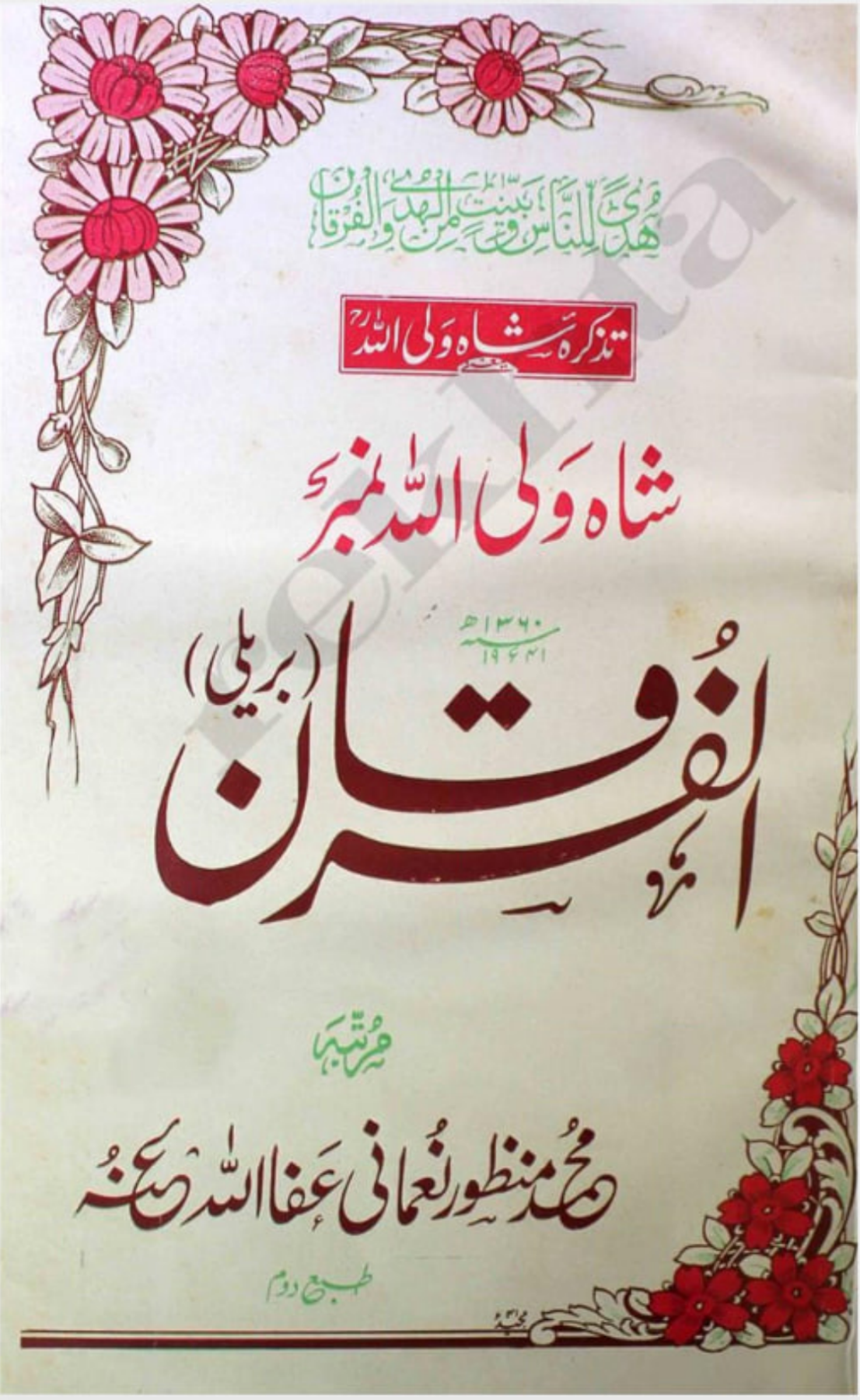
The following is the translation of an article on Shāh Walīullāh, penned by Shaykh Owais Nagrāmī Nadwī for a special 1940 edition of Shaykh Manẓūr Nuʿmānī's magazine titled al-Furqān.
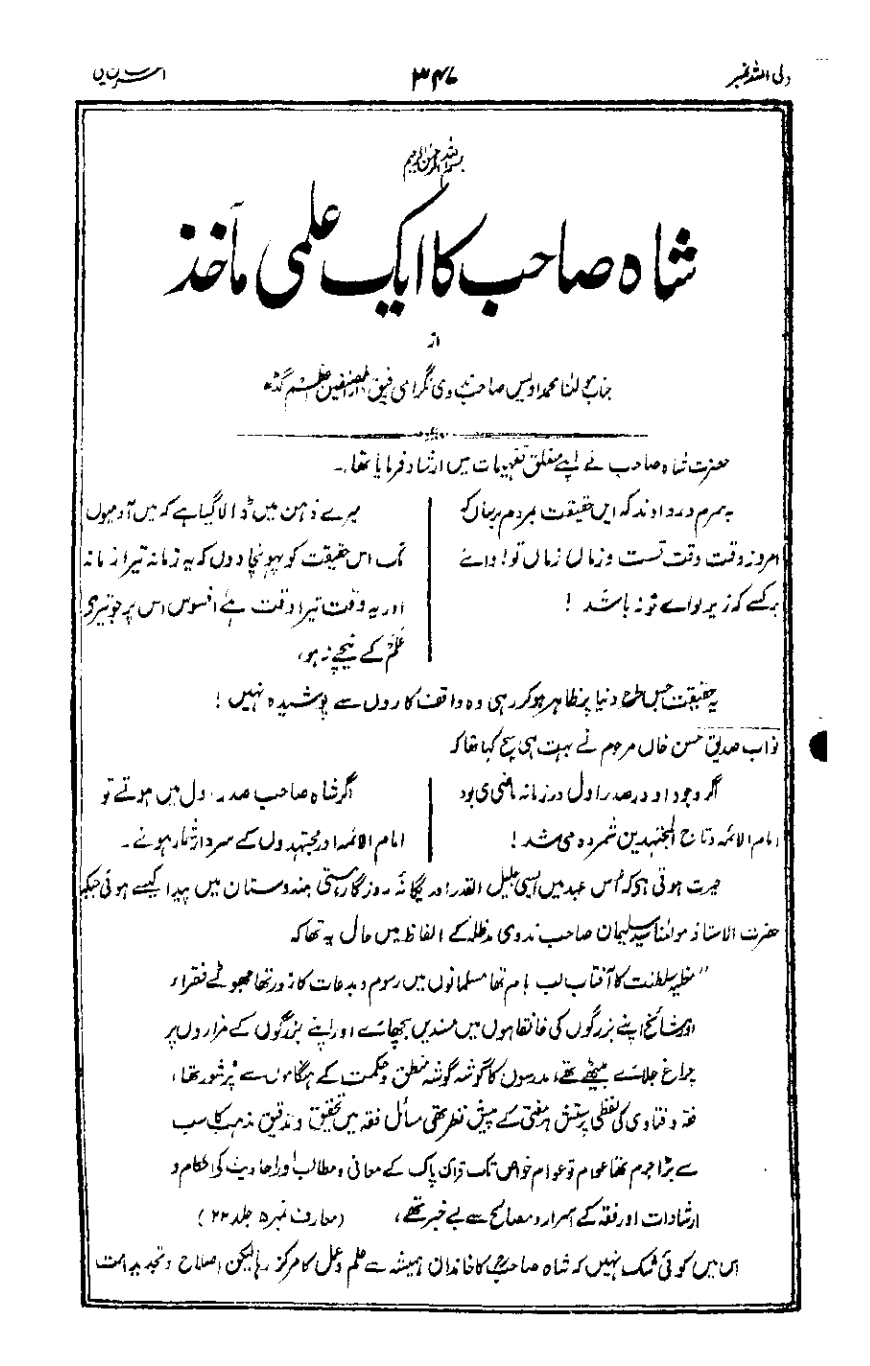
A Scholarly Source of Shah Walī Allāh
Shah Walī Allāh, in his Tafhīmāt, states concerning himself:
“By divine grace it has been placed upon my heart to convey this truth:
that today is your time, and this time is your time.
Woe to the one who is not under your banner.”
This reality, as it gradually unfolded upon the world, has not remained hidden from those who possess insight. The late Nawāb Ṣiddīq Ḥasan Khān spoke with complete truth when he said:
“Had his existence been in the earliest generations, in a former age, he would have been counted as the Imām of the Imams and the crown of the mujtahids.”
That is to say, had Shah Walī Allāh belonged to the earliest period of Islam, he would have been regarded as the foremost of the Imams and the leader of the mujtahids.
The Intellectual Climate of the Age
It is astonishing how, in such an age, a personality of such lofty stature and singular distinction could emerge in India—especially when, in the words of our Ustādh Mawlānā Sayyid Sulaymān Nadwī (may Allah preserve him), the prevailing condition was as follows:
“The sun of the Mughal Empire was at its setting. Among the Muslims, customs and innovations had gained dominance. Minor faqīrs and shaykhs sat upon platforms in their khānqāhs, lighting lamps at the tombs of their elders.
Every corner of the madrasahs resounded with the tumult of logic and philosophy. Literal worship of fiqh and fatwā lay before the eyes of every petty muftī. Research and critical inquiry in jurisprudence were considered the gravest crimes against the madhhab.
Not only the common people, but even the elite were deprived of understanding the meanings and objectives of the Noble Qurʾān, the rulings and guidance of the aḥādīth, and the inner wisdoms and purposes of fiqh.” [Maʿārif 5:23]
There is no doubt that Shah Walī Allāh’s family had long been a centre of learning, but the share of reform and renewal of the Ummah—through the union of knowledge and practice, companionship in religion, and the spiritual capital that fell to Shah Walī Allāh’s lot—has no parallel.
Teachers and the Nature of His Renewal
Among Shah Walī Allāh’s Indian teachers are found the honoured names of his father, Ḥaḍrat Shah ʿAbd al-Raḥīm, and Maulana Muḥammad Afḍal, known as Ḥājī Siyālkotī. Yet even in the biographies of these venerable figures, we do not find anything so striking that would allow us to assess the extent to which they directly shaped Shah Walī Allāh’s reformative achievements.
The reality is that Shah Walī Allāh’s movement of reform and renewal was, to a great extent, rooted in the Sunnah, and in those sciences and forms of knowledge which—by the grace and favour of Allah—were unveiled to him, and which he repeatedly mentions in his writings. This unveiling of the inner secrets and realities of the Sharīʿah transformed Shah Walī Allāh’s entire world, raising him far above not only his contemporaries, but even, in rank, many of his predecessors and successors.
Another factor that, inour view, cultivated Shah Walī Allāh’s lofty vision and high resolve was his impartial study of the thoughts and lives of the great scholars of Islam.
Although many scholarly works were before Shah Walī Allāh, such as those of ʿIzz al-Dīn ibn ʿAbd al-Salām, Imām al-Ghazālī, Shaykh Abū Ṭālib al-Makkī, and others. Among these scholars was one towering personality whose life and ideas remained especially before Shah Walī Allāh: a figure who occupies a uniquely eminent place in Islamic history, whose very being became the cause of a magnificent movement of reform and renewal. By this we mean Shaykh al-Islām Ibn Taymiyyah.
Journey to the Ḥijāz
In the year 1143 AH, Shah Walī Allāh travelled from India to the Ḥijāz and benefited from the scholars of the Two Sanctuaries. Among his teachers there was a venerable scholar named Shaykh Ibrāhīm Kurdī, who used to say regarding Shah Walī Allāh:
“Walī Allāh takes from me the chain of transmission of words,
and I take from him the chain of transmission of meanings.”
Shaykh Ibrāhīm Kurdī was a man of expansive learning and lofty vision—a devoted admirer, indeed a staunch defender, of Shaykh al-Islām Ibn Taymiyyah.
Imam Ibn al-Ālūsī al-Baghdādī writes about him in Jalāʾ al-Ghaynayn (p. 26), “He was Salafī in creed and a defender of Shaykh al-Islām Ibn Taymiyyah.”
It appears that it was precisely the blessing of this companionship that inclined Shah Walī Allāh toward the works of Shaykh al-Islām Ibn Taymiyyah and Ḥāfiẓ Ibn al-Qayyim, thereby forming a spiritual and intellectual linkage between one Imam of reform and another. Shah Walī Allāh benefited fully from both of these luminaries, and indeed defended them openly.
Shah Walī Allāh on Imam Ibn Taymiyyah
The author of Jalāʾ al-Ghaynayn (quotes) Shah Walī Allāh from the Tafhīmāt as saying:
"On this basis, we formed our belief regarding Shaykh al-Islām Ibn Taymiyyah (may Allah have mercy on him). Upon investigating his condition, we found him to be a scholar of the Book of Allah and its linguistic and legal meanings; a preserver of the Sunnah of the Messenger of Allah ﷺ and the reports of the Salaf; deeply knowledgeable of their linguistic and legal significations; a master of grammar and language; firmly grounded in the principles and subsidiary rulings of the Hanbali school; outstanding in intelligence, eloquence, and defence of the creed of Ahl al-Sunnah.
No act of sinfulness or innovation has been reported from him—except for those matters for which restrictions were imposed upon him—and none of these lacked evidence from the Qurʾān, the Sunnah, and the reports of the Salaf.
A scholar of this calibre is rare in the world. Who is capable of matching him in writing and exposition? Those who opposed him did not attain even a tenth of what Allah granted him. The disputes concerning him among scholars resemble the disputes among the Companions themselves. What is obligatory in such matters is restraint of the tongue, except in speaking good.”
Reflect carefully upon these words and observe how deeply Shāh Walī Allāh was influenced by Shaykh al-Islām Ibn Taymiyyah’s breadth of knowledge, mastery of jurisprudence, and passionate zeal in defence of Islam.
Imam Ibn Taymiyyah’s Influence in Shah Walī Allāh’s Works
Throughout Imam Shah Walī Allāh’s writings, the thoughts of Shaykh al-Islām Ibn Taymiyyah appear repeatedly. In some places, entire passages are reproduced verbatim without attribution, likely due to the prevailing prejudices of the time.
For example, consider the following passage from Ḥujjat Allāh al-Bālighah, where Shah Walī Allāh writes:
"Among the Companions and those after them were some who recited the basmalah and others who did not; some who recited it aloud and others who did not; some who performed qunūt in the Fajr prayer and others who did not; some who performed wuḍūʾ after cupping, nosebleed, or vomiting and others who did not; some who performed wuḍūʾ after touching the private parts or touching women with desire and others who did not; some who performed wuḍūʾ after contact with fire and others who did not; some who performed wuḍūʾ after eating camel meat and others who did not.
Despite all this, they would pray behind one another. Thus, Abū Ḥanīfah and his companions, as well as al-Shāfiʿī and others (رضي الله عنهم), would pray behind the imams of Madinah from among the Mālikīs and others, even though they did not recite the basmalah either silently or aloud. Al-Rashīd once led the prayer after having undergone cupping, and Imām Abū Yūsuf prayed behind him and did not repeat the prayer, because Imām Mālik had issued a fatwā that wuḍūʾ was not required. Imām Aḥmad ibn Ḥanbal held that wuḍūʾ was required after nosebleed and cupping. When he was asked: ‘If the imam bleeds and does not perform wuḍūʾ, will you pray behind him?’ he replied: ‘How could I not pray behind Imām Mālik and Saʿīd ibn al-Musayyib?’”
This passage appears verbatim in Ibn Taymiyyah’s Fatāwā, volume two.
Likewise, in al-Fawz al-Kabīr, Shah Walī Allāh states regarding the causes of revelation:
“From an inductive examination of the statements of the Companions, it becomes clear that their saying ‘This verse was revealed concerning such-and-such’ is not restricted solely to an incident that occurred during the lifetime of the Prophet ﷺ and became the direct cause of revelation. Rather, they also apply this expression to anything upon which the verse truly applies, whether that event occurred during the Prophetic era or afterward.”
This same meaning is transmitted by Ḥāfiẓ Jalāl al-Dīn al-Suyūṭī in al-Itqān, quoting Ibn Taymiyyah:
Ibn Taymiyyah said, “Their statement ‘This verse was revealed concerning such-and-such’ sometimes refers to the actual cause of revelation, and at other times it means that the matter falls under the scope of the verse, even if it was not the direct cause—just as one might say: ‘This verse concerns me.’”
(al-Nawʿ al-Tāsiʿ)
Conclusion
After these clear statements, if we arrive at the conclusion that the intellectual revival led by Shāh Walī Allāh was, to some extent, influenced by the ideas of Shaykh al-Islām Ibn Taymiyyah, then such a conclusion would not be unfounded.
We would like to express our sincere gratitude to Shaykh ʿUthmān ibn Ṣābir, Umm Zaynab bint Ṣābir, and Zaynab bint Ṭāhir for their invaluable efforts and dedication in bringing this translation to light.