
The following is the translation of a lost article penned by the late Shaykh Dr Shuʿayb al-Nagrāmī al-Azharī رحمه الله (d. 2026) in July 2003 for Ṣawt al-Ummah which is a monthly Arabic scholarly journal published by al-Jāmiʿah al-Salafiyyah, Banāras, India. The article was recently found in the university's library archives and scanned at our request thanks to help from our dear brother Shaykh As'ad ibn Ibrāhim. Ṣawt al-Ummah serves as one of the institution’s principal academic and daʿwah platforms, dedicated to the dissemination of sound Islamic knowledge in the Arabic language and extending the voice of Indian scholarship to a wider scholarly audience.
A Study of the Translation of the Meanings of the Noble Qurʾān into the English Language
The Noble Qurʾān is the eternal record that contains within its sūrahs and āyāt all the concerns of humanity, in its present and its future. Humanity continued to live without hope and without purpose, spending long stretches of life upon the earth, gathering from the burdens and pains of life that which its weakness could not bear, fashioning from the hardships of this world and its darkness the ornaments of its thoughts, and forging from its struggles a glory that neither brought it happiness nor placed before it a single sign to guide it toward a destination, until the trustworthy revelation descended with the Noble Qurʾān upon the noble Messenger ﷺ. This marked a great transformation for humanity: its steps were set aright upon the path of life, it walked upon the earth, now taken as a dwelling, in contentment and well-being, and within its breast spread the motives of love and hope.
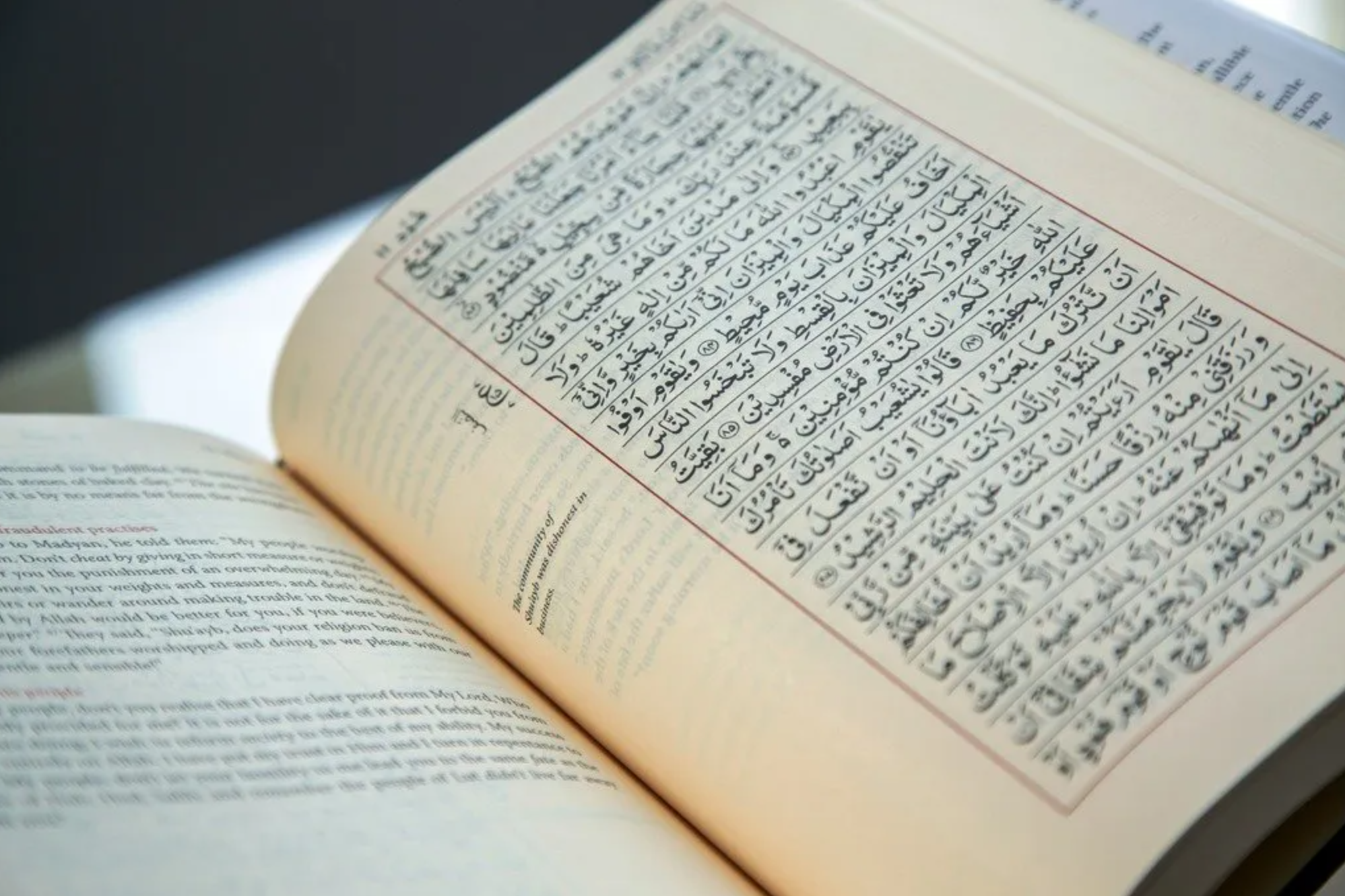
This trustworthy revelation, namely the Noble Qurʾān, is an overflowing ocean of diverse sciences and knowledge. Whoever desires to obtain its pearls and jewels must dive into its depths. The Qurʾān remains the pinnacle of eloquence; it is the miraculous Book revealed to the unlettered Prophet ﷺ, bearing witness to his truthfulness. Within its two covers lies the proof of its perfection, the sign of its miraculous nature, and the evidence that it is a revelation from the All-Wise, the All-Knowing:
وَنَزَلَ بِهِ الرُّوحُ الْأَمِينُ
عَلَىٰ قَلْبِكَ لِتَكُونَ مِنَ الْمُنذِرِينَ
بِلِسَانٍ عَرَبِيٍّ مُّبِينٍ
Allah, the Exalted, has spoken the truth.
The relationship of Europe with Islam began at the end of the first century Hijrī, that is, from an early period in the history of Islam. Europe was astonished when it heard of Islam spreading rapidly in Shām, Egypt, and Africa. When Islam knocked on the doors of Christian Europe, Europeans were living in isolation within themselves, in a stagnant Europe immersed in the darkness of the Middle Ages, under the domination of feudal lords and the authority of the Church.
Christians who fled from the East before the advancing Muslim armies played a major role in presenting a distorted image of Islam and its Prophet ﷺ. Their erroneous religious beliefs prevented them from forming a correct understanding of Islam. Thus, Christian Europe came to view Islam as a problem that threatened its very existence. Europe imagined that Islam was an invention of the Messenger of Allah ﷺ, and this distorted perception of Islam and its trustworthy Messenger ﷺ persisted until the eleventh century CE. This imagined image reached schools and monasteries in the form of structured teaching, encouraging its acceptance, and consequently, this image became deeply ingrained in European thought in a disturbing manner.
The orientalist Sozran claims that the twelfth century CE marks a new phase in Europe’s view of Islam, a view which, according to him, was characterized by rationality and drove away the earlier imaginary perceptions among European intellectuals. With the beginning of the fourteenth century CE and the rise of the Ottoman state, Europe realized the resurgence of Islamic power, and feelings of hatred and fear became evident. When we reach the sixteenth and seventeenth centuries CE, we observe a fundamental transformation in the stance of both Islamic and Christian civilizations. The trajectory of each began to move in the opposite direction: the Islamic civilization entered a phase of decline, while its European counterpart experienced rapid ascent. The Muslim world now faced a Europe that was different from that of previous centuries; fear had disappeared and was replaced by a sense of Christian superiority. This outlook emerged from a feeling of dominance at a time when the strength of the Muslims had weakened, and Islam, which had once shaken the gates of Europe, became, in the European imagination, a quiet dream of the past.
This fundamental and civilizational transformation had a clear impact on the research and writings of the Europeans. A text has defined the orientalists by stating that these orientalists expressed their interest in studying Islam from one angle, and they presented Islam in terms of Book, Sunnah, and Messenger. However, their objective, regardless of whether it was presented under the guise of objectivity, remained essentially the same, even if their methods and styles differed. Their general principles were:
Firstly: Approaching the Noble Qurʾān with a superficial outlook.
Secondly: Departing from the teachings and rulings of the Sharīʿah.
Thirdly: Displaying intense bias in their positions, assumptions, and ideas regarding the heritage attributed to Islam and in their presentation of it.
This organized and incited intellectual and ideological tendency became a defining feature of the orientalist movement and its scholars. They focused on certain aspects of the meanings of the Noble Qurʾān through translations carried out either by the orientalists themselves or by their affiliates, by which is meant those groups that lived within the Islamic East but were Western, or more precisely, Crusader in their intellectual outlook, culture, and tradition.
The Italian orientalist L. Morocci is regarded as the first Western translator of the meanings of the Noble Qurʾān. His translation became the foundation upon which all subsequent translations into various European languages were based. In the year 1448 AH, the first English translation of the meanings of the Qurʾān appeared, and it was a literal translation of the Italian version by “Morocci.”
In the year 1724 CE, the orientalist George Sale translated the meanings of the Noble Qurʾān into English. His translation was admired among orientalists because he did not rely solely on the Italian translation; rather, he supplemented it with commentary and explanation of the noble āyāt, drawing upon recognized and widely circulated tafsīr works in the Islamic East such as those of al-Ṭabarī, Ibn Kathīr, and al-Bayḍāwī.
George Sale divided his introduction into two parts. In the first section, he discussed the general history of the Arabs, referring to the activities of Christians who were living in the Arabian region at that time. In the second section, he outlined the characteristics of the Noble Qurʾān and briefly summarized the history and beliefs of certain Islamic sects that emerged in the Islamic East after the end of the caliphate of the two Shaykhs (Abū Bakr and ʿUmar رضي الله عنهما).
The translation of “Morocci” remained a primary reference for those orientalists who showed interest in Islamic heritage. After a period of time, in the year 1841 CE, the orientalist J. M. Rodwell (Radwal) revised Morocci’s translation. He removed certain scientific terms and expressions that were present in Morocci’s version and replaced them with terms that were current and widely used in his own time.
However, alongside this linguistic effort, Rodwell committed a serious distortion in the arrangement of the sūrahs of the Noble Book. In his translation, he arranged the sūrahs according to the order of their revelation. He began with Sūrat al-ʿAlaq and ended with Sūrat al-Māʾidah. This clearly indicates that Rodwell was influenced by, and indeed adhered to, the mythical beliefs of certain esoteric sects that claim alteration in the arrangement of the sūrahs of the Noble Book.
Approximately forty years later, the German orientalist Meksemer, a professor of Eastern languages at the University of Oxford, formed a committee of experts in Eastern languages to translate the scriptures and all sacred books into English. The orientalist Bamar was selected to translate the meanings of the Noble Qurʾān into English. His translation appeared in two large volumes, and it was introduced by the well-known British orientalist Nicholson. This translation became an important reference for specialists in Eastern languages, especially those engaged in Islamic studies in European universities. The translation of “Bamar” went through several editions, the last of which appeared in 1922 CE.
In addition to these, there were orientalists who limited themselves to translating the meanings of certain sūrahs of the Noble Qurʾān. For example, in 1842 CE, the orientalist D’Herbelot (referred here as Dilolin) translated the meanings of Sūrat al-Baqarah and Sūrat Āl ʿImrān. In his translation, he addressed topics related to tawḥīd, prophethood, revelation, the Day of Resurrection, angels, Paradise and Hell, and he also referred to the names of the Prophets and the heavenly books mentioned in the two sūrahs.
This translation was reprinted in 1876 CE, with an added introduction on the sciences of the Qurʾān. Alongside this, a number of orientalists were listed among those who translated portions of the Qurʾān, including Bishop Cecil, Sir William Muir, known for his hostility toward Islam and the Messenger ﷺ, and the orientalist Margoliouth, a professor at Oxford University, who relied heavily in his translation of Sūrat Āl ʿImrān on the tafsīr of al-Bayḍāwī.
All of these translations appeared toward the end of the eighteenth century CE. It is noteworthy that in all these translations, the Arabic Qurʾānic text was entirely absent. The reason for this is clear and unambiguous: to eliminate the language of the Noble Qurʾān, which was one of the primary objectives of the orientalist movement.
This has been a very brief overview of the translations of the meanings of the Noble Qurʾān, or some of its sūrahs, into the English language by the orientalists. We now turn to examine the translations produced by the followers of the orientalists, or more precisely, the nurtured agents of colonial Crusader influence who lived in the Islamic East and carried out the objectives of the missionary-orientalist movement, which aimed at distorting the doctrine of tawḥīd and casting doubt upon the teachings of our true Islamic religion.
The Qādiyānī movement, an undermining movement fostered by Crusader influence in the Indian subcontinent and supported by Christian colonialism, is considered among the prominent movements in the Islamic East that took an interest in translating the meanings of the Noble Qurʾān.
In the year 1918 CE, the Qādiyānī translator Mawlawī Muḥammad ʿAlī Lāhorī translated the meanings of the Noble Qurʾān into English, including the Arabic text of the Book of Allah. This translation was welcomed by the orientalists in the West and their followers in the East, despite the fact that it distorted the pure doctrine of tawḥīd revealed by Allah in His clear Book. For example, the Noble Qurʾān affirms that our master ʿĪsā ibn Maryam عليه الصلاة والسلام was raised to the heavens, whereas the Qādiyānī translator asserts, indeed claims, the death of al-Masīḥ عليه الصلاة والسلام. It appears that Lāhorī was influenced by Magian beliefs, as under this influence he divided the Will of Allah سبحانه وتعالى into two categories: the first consisting of angels as a force of good, and the second consisting of jinn as a force of evil. It is evident that this interpretation mirrors the dualistic belief of the Magians, who assert the existence of two opposing forces, one of good and one of evil, engaged in an ongoing struggle until the Day of Judgment.
In addition to this, the Qādiyānī translator denied the miracles of the Prophets عليهم الصلاة والسلام which are affirmed by the Noble Book. His interpretation of Paradise and Hell contradicts the pure Islamic creed in both form and substance. Despite all these fabrications and falsehoods, the translator claims that his translation of the meanings of the Noble Qurʾān and his explanation of its clear āyāt do not contradict the authentic Islamic creed as clarified and affirmed by the scholars of Ahl al-Sunnah in their works.
In the year 1926 CE, the Indian writer ʿAbdullāh Yūsuf ʿAlī, who belonged to the Bāṭinī Bohra sect, translated the meanings of the Noble Qurʾān into English. In reality, the translator’s upbringing in a Bāṭinī environment, also filled with the superstitions of certain Ṣūfīs and idol-worshippers, alongside his European education and admiration for the English language, all played a significant role in shaping his translation of the Book of Allah.
For instance, in footnote (2819), the translator affirms the existence of the “just Imam” as a condition for the legitimacy of jihād. In footnote (5749), he claims that the Imam alone represents the “divine light,” and in footnote (4749), he asserts that the Imam is guided by this divine light. It is clear that all these claims, which are held by Bāṭinī sects, contradict the doctrine of tawḥīd.
In his translation, ʿAbdullāh Yūsuf ʿAlī adopts the methodology of “esoteric interpretation” (al-tafsīr al-bāṭinī), influenced by Abū Jaʿfar al-Manṣūr al-Kulaynī and his followers. In footnote (2504), he claims that certain āyāt from Sūrat al-Baqarah contain Bāṭinī doctrines. At times, the translator even contradicts the Qurʾānic text itself in explaining certain āyāt. For example, in footnote (2669), he claims that marrying more than one woman constitutes ظلم (injustice), which is a clear contradiction of the noble āyah:
فَانكِحُوا مَا طَابَ لَكُم مِّنَ النِّسَاءِ مَثْنَىٰ وَثُلَاثَ وَرُبَاعَ ۖ فَإِنْ خِفْتُمْ أَلَّا تَعْدِلُوا فَوَاحِدَةً
The era of ʿAbdullāh Yūsuf ʿAlī was a golden age of the British Empire, which ruled half of the globe. Under the influence of his Crusader-influenced culture, which he admired, he was led to compare the truthful story of Yūsuf عليه الصلاة والسلام in the Noble Qurʾān with the tales and legends of love found in Greco-Christian heritage. On page (592), in footnote (2764), he compares the story of Mūsā عليه الصلاة والسلام with the two daughters of the Prophet Shuʿayb عليه الصلاة والسلام to scenes from English theatrical works by the playwright William Shakespeare.
It is evident that these interpretations do not conform to the Book of Allah nor the purified Sunnah of His Messenger ﷺ. Rather, they stand in clear contradiction to the doctrine of tawḥīd and the methodology of the righteous predecessors (al-salaf al-ṣāliḥ).
In addition to this, there exists a translation of certain sūrahs in the book al-Furqān by Shaykh Bādshāh Ḥasan. This translation is Bāṭinī in both thought and methodology and was published by “Madrasat al-Wāʿiẓīn,” affiliated with one of the Bāṭinī sects in the city of Lucknow in northern India, which is considered one of the centers of Bāṭinī groups in the Indian subcontinent.
It is also worth mentioning that there are translations of the meanings of the Noble Qurʾān produced by some researchers in the Islamic East who were neither affiliated with the orientalist movement nor influenced by its followers, and who were also not adherents of esoteric or superstitious ideologies.
Among the foremost of these researchers is Dr. ʿAbd al-Ḥakīm al-Nāmī, who in his early life was a Qādiyānī, but Allah سبحانه وتعالى blessed him with the blessing of Islam. In the year 1905 CE, Dr. al-Nāmī translated the meanings of the Noble Qurʾān first into English and then into Urdu, taking care to include the Arabic text in both translations. His English translation was printed in London in 1905.
At the end of the second decade of the same century, in 1920 CE, Muḥammad Marmaduke Pickthall translated the Qurʾān under the title: “The Meaning Of The Glorious Qurʾān.” The translator was born in London in 1875 and publicly embraced Islam in 1914. After accepting the doctrine of tawḥīd, he focused on reconciling differences between the Turks and the British during World War I. Pickthall regarded the Ottoman Caliphate as a representation of Islam and the Muslims, and he strongly supported it, defending it within British political circles, an indication of his love for Islam.
In 1920, Pickthall traveled to Bombay in India and worked as a journalist for an English magazine. However, he did not remain long in that role, as his love for his Islamic faith and his zeal to spread the teachings of the Qurʾān and Sunnah drove him to travel to Hyderabad, which at the time was an important center for the dissemination of Islamic heritage. Upon arriving there, he became the editor of the journal “Islamic Culture,” which published scholarly research on Islam and its beliefs in an engaging style.
During his time at the journal, Pickthall began to consider translating the meanings of the Noble Qurʾān. He presented this idea to the authorities and requested a two-year leave to dedicate himself to this work. Allah سبحانه وتعالى granted him success. After completing his translation, he traveled to Egypt and presented it to Shaykh Muṣṭafā al-Marāghī and to the Council of Senior Scholars at al-Azhar. After receiving their approval, his translation was published in 1920 in both London and New York simultaneously, initially without the Arabic text. However, the translator later recognized this as an error, and in subsequent editions, he included the Arabic text alongside the translation.
In reality, Pickthall was an honest and sincere researcher. In his introduction, he acknowledged that the miraculous Book of Allah cannot be translated into any language in a complete sense; rather, it is impossible to fully render it. Nevertheless, in his work, he relied on trusted references recognized by Muslims, with the intention of conveying the teachings of Islam to non-Arabic speakers. We do not doubt the sincerity of Pickthall nor do we diminish the value of his work and effort. However, despite this, his translation contains errors—not deliberate, but due to a lack of full mastery and depth in the Arabic language and its eloquence, which has been described by an Arab poet as “hidden pearls.”
For example, Pickthall translated the word “al-hady” in Sūrat al-Baqarah (āyah 196) as “gifts,” whereas it actually refers to sacrificial animals. Similarly, he translated the phrase “fī biḍʿ sinīn” in Sūrat al-Rūm (āyah 30:4) as “within ten years,” whereas the word biḍʿ refers to a number between three and nine. He also mistranslated the words referring to migration (hijrah) in Sūrat al-Naml (āyah 41), using the term “fugitives,” which in English refers to criminals fleeing justice. Likewise, describing the Hijrah of the Messenger ﷺ as “flight” constitutes a direct affront to the steadfastness of the unlettered Prophet ﷺ in the face of falsehood and tyranny. The Hijrah from Makkah to Madīnah was not an escape but was by divine command. This blessed migration, which every Muslim takes pride in, was in reality the beginning of the first Islamic society in Madīnah.
This has been a brief examination of some English translations of the meanings of the Noble Qurʾān that have been and continue to be circulated among readers of the Book of Allah. There is an urgent need for a translation of the meanings of the Noble Qurʾān into English that is free from ideas opposing pure tawḥīd, distanced from foreign Ṣūfī influences introduced into Islam, and purified from myths, superstitions, and talismans.
In response to this need, the Kingdom of Saudi Arabia, under the leadership of the late King ʿAbd al-ʿAzīz رحمه الله, may Allah grant him a place in His vast Paradise, took the initiative in spreading the call of tawḥīd across the globe. The Custodian of the Two Holy Mosques established the King Fahd Complex for the Printing of the Noble Qurʾān, a clear demonstration of the Kingdom’s commitment to disseminating the creed of tawḥīd and raising high the banner of Islam.
In line with this effort, the Presidency of Scientific Research, Fatwā, Daʿwah, and Guidance, under the leadership of Shaykh ʿAbd al-ʿAzīz ibn Bāz رحمه الله, undertook the preparation of an English translation of the meanings of the Noble Qurʾān. This translation, InshāʾAllāh, represents the understanding of the righteous predecessors and fills a significant gap in this field. I had the honor of being a member of one of the committees tasked by the Presidency with preparing this translation, under the supervision of the Director of Publications and Translation.
Finally, I appeal to the authorities in the Kingdom of Saudi Arabia, the land of revelation, where Allah سبحانه وتعالى revealed His Noble Book and where His law is implemented, to give attention to translating the meanings of the Noble Qurʾān into the Urdu language, which is considered the third most important Islamic language in terms of heritage.
Most existing Urdu translations reflect the viewpoints of deviant sects such as the Qādiyānīs, the Bāṭinīs, and the grave-worshippers. These translations distort the doctrine of tawḥīd and promote superstitious beliefs that have no connection with the Book and the Sunnah.
Indeed, there exist Urdu translations that do not contradict the doctrine of tawḥīd, but their language, dating back over a hundred years, has become difficult for modern Urdu speakers to understand. These translations require the attention of those who have taken upon themselves the most noble and honorable responsibility: the responsibility of spreading the call of tawḥīd.